


Four Flavours, One Balance: The Idea Behind Thai Cooking
Thai food confuses beginners for a specific reason: it refuses to pick a lane. A single dish can be hot, sour, salty, and sweet at once — and that simultaneity is not chaos, it is the entire philosophy. Where much Western cooking builds one dominant flavour, Thai cooking balances four (five, with bitterness in the north and northeast), tuned dish by dish and adjusted at the table with a caddy of condiments: fish sauce for salt, lime or vinegar for sour, sugar for sweet, chillies for heat. This guide to thai food for beginners explains the flavour map, the dishes that teach it best, the heat scale nobody warns you about, and the etiquette that turns a meal in Thailand from eating into participating.
The Dishes That Teach the Map
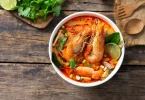
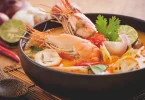
Learn the cuisine through its canonical plates. Tom yum goong — hot and sour prawn soup with lemongrass, galangal, and lime — is the flavour balance in a bowl: sour and hot in front, herbal depth behind. Pad thai, likely your first encounter, teaches the sweet-sour axis: tamarind tang against palm sugar, softened by egg and peanut, finished with lime at the table. Green curry (gaeng keow wan) shows how coconut milk carries heat — rich and sweet on entry, chilli arriving late and building; its red and massaman cousins trade the fresh green chillies for dried spice warmth and roasted depth respectively. Som tam, the green papaya salad of the northeast, is the advanced class: pounding raw garlic, chilli, lime, fish sauce, and palm sugar into something electric — order it after your palate has acclimatised. And mango sticky rice closes every lesson sweetly. Eat this sequence over a week in Thailand and you will understand the cuisine better than a month of recipes abroad — especially combined with the market visits and street-food strategy in our companion Thailand travel tips.
Heat: The Honest Conversation to Have With Yourself
The single most useful survival skill is calibrating chilli. Thai heat levels, roughly: “not spicy” (mai pet) may still arrive with a whisper of chilli; “a little” (pet nit noi) is a Western medium; “medium” (pet glang) will make most visitors sweat happily; and Thai-spicy (pet baep thai) is a commitment, not a setting. Two rules keep meals joyful. First, communicate before cooking — after is archaeology. In restaurants used to foreigners, pointing and smiling with the level named works; in local shops, a translation app earns its keep. Second, treat rice and coconut as equipment, not sides: plain rice is the firebreak between bites, coconut milk dishes genuinely cool the palate, and dairy (a lassi-style drink, where available) rescues where water merely spreads the burn. Build tolerance gradually across a trip rather than heroically on night one — the cuisine opens up as you do, and dishes balanced for full heat are the cuisine’s masterpieces precisely because every other flavour is turned up to match.
How Meals Actually Work: Sharing, Rice, and the Table Caddy
Thai meals are communal engineering. Dishes are ordered to share — the rough rule is one dish per person plus rice for the table — and arrive as ready, to be eaten together in no course order; your curry, soup, salad, and stir-fry coexist, mixed bite by bite over rice. Rice is the meal’s centre (the Thai phrase for eating, gin khao, literally means “eat rice”), and the spoon-and-fork technique — fork pushing food onto the spoon, spoon to mouth — is the local standard, with chopsticks reserved mainly for noodle soups eaten alone. The condiment caddy is not decoration: it exists because the kitchen seasons to a house balance and the table finishes to personal taste, exactly the philosophy this guide opened with. Finally, breakfast is a discovery: rice soup (khao tom), grilled pork skewers with sticky rice, and Chinese-influenced dough sticks with condensed milk — a meal Western visitors skip by habit and regret once tried.
Eating Well Anywhere: Street Stalls to Restaurants
The beginner’s hierarchy of trust: eat where it is busy. A stall with a queue and fast turnover serves food cooked to order from fresh stock; the plastic-stool places near markets and transport hubs are where the city itself eats, usually better and cheaper than the restaurant row. Order the stall’s speciality (each is famous for one or two dishes) rather than a survey of the menu. Drink sealed water or the stall’s boiled options, be relaxed about ice from factories (the cylindrical tubes with holes are commercially made and standard everywhere), and carry small notes — street prices are small and change is kindness. In restaurants, the same flavour rules apply at higher comfort; ask for the Thai menu’s translations and do not let a tourist menu’s caution season your food for you. Thai food rewards the curious with compound interest: every meal teaches the palate, and the palate keeps asking better questions.
One Country, Several Cuisines
Everything above describes the central Thai canon; the regions rewrite it in delicious dialects. Northern food (Lanna) is milder, herbal, and pork-rich — khao soi, the curried noodle soup crowned with crispy noodles, is its ambassador and many visitors’ single favourite bowl. The northeast (Isaan) shares its table with Laos: fiercer heat, fermented fish depth, grilled meats, and sticky rice eaten by hand as the staple rather than a side. The south cooks hottest of all, with turmeric-yellow curries and seafood at the centre. Purposeful eating across a trip — central in Bangkok, northern in Chiang Mai, southern on the coasts — is a geography lesson no classroom matches.
The Bottom Line
Thai food for beginners comes down to balance and bravery: hot, sour, salty, and sweet tuned together; learned through tom yum, pad thai, green curry, and som tam in that order; heat chosen honestly and managed with rice; meals shared around rice with the table caddy finishing the seasoning. Master those, and Thailand stops being a menu you survive and becomes one you read fluently.

[…] for the whole trip, and the translation app is your menu-decoder for the food adventures in our thai food for beginners guide. Etiquette essentials: dress covered (shoulders, knees) for temples and carry a light scarf […]