A traditional Thai wedding is not one ceremony but a series of small rituals, most of them held on a single morning in the bride’s family home or a hotel function room. Each step has a meaning, and each one involves family, elders and often monks. Whether you are a guest, marrying a Thai partner, or planning a wedding in Thailand from abroad, knowing the order of the day makes it far easier to follow and enjoy.This guide walks through the main Thai wedding traditions in the order they usually happen, what guests are expected to do, the role flowers play, and how to make a marriage in Thailand legal.
Choosing an auspicious date
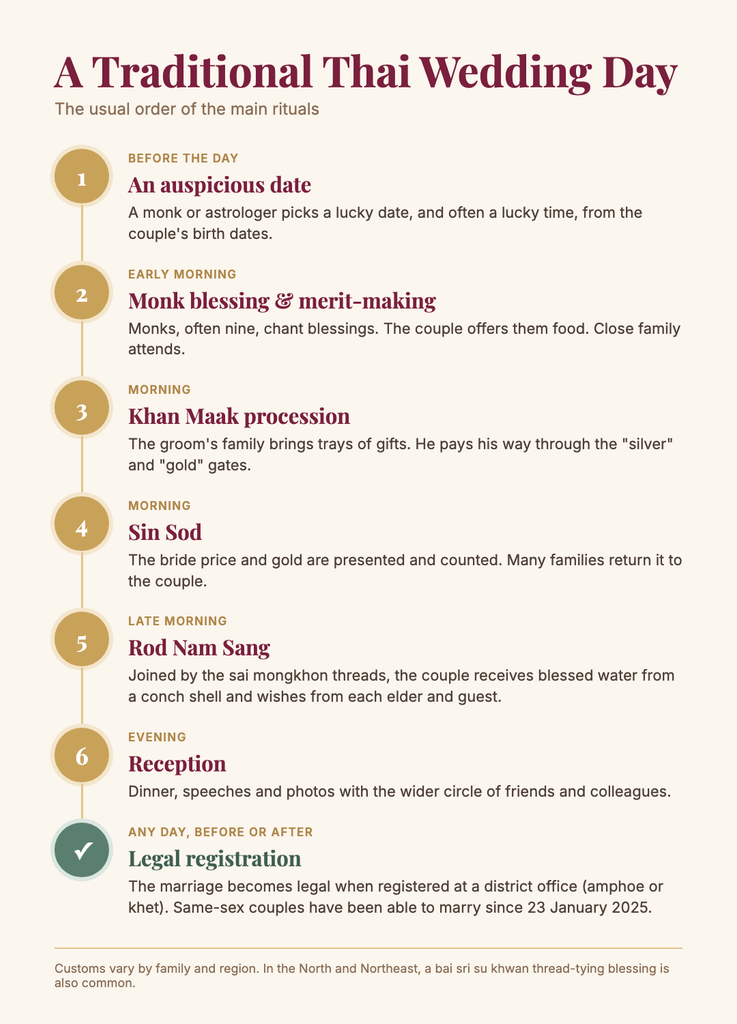
Many Thai families do not pick a wedding date by convenience alone. They ask a monk or an astrologer to choose an auspicious day, and often an auspicious time, based on the couple’s birth dates. The ceremony is then timed around that moment, which is why a traditional Thai wedding often starts early in the morning.
If you are planning a wedding in Thailand with a Thai partner, expect the family to have strong views on the date. It is worth agreeing on it before booking venues or flights.
Morning merit-making with monks
The day usually opens with a Buddhist blessing. The couple invites monks, often nine, since nine is considered a lucky number in Thailand, to chant blessings for the marriage. The couple then offers the monks food and other necessities as an act of merit-making. Guests at this part are usually close family, and it is quiet and formal.
Guests who attend should dress modestly, remove their shoes when asked, and avoid pointing their feet towards the monks.
The Khan Maak procession and the door ceremony
Next comes the Khan Maak procession, one of the most joyful Thai wedding traditions. The groom and his family walk to the bride’s home carrying trays of gifts, called khan maak. The trays traditionally hold symbolic items such as betel nuts and leaves, sweets, fruit, and the engagement gifts. Drums, singing and dancing often lead the way.
Before the groom can reach the bride, he has to pass a series of “doors” set up by her relatives and friends. These are usually people holding a ribbon, chain or belt across the path. At each one, the groom pays a small fee in an envelope or answers a playful challenge. The doors are often called the silver gate and the gold gate, and the payments rise at each one. It is lighthearted, loud and a favourite moment for photographs.
Sin Sod: the bride price
Once inside, the families present the sin sod, the bride price or dowry, alongside gold jewellery. It is laid out on trays and counted in front of the guests as a sign of respect for the bride’s family and of the groom’s ability to provide.
Sin sod is a long-standing Thai custom, but the amount and handling differ a lot from family to family. In many modern weddings, part or all of the money is given back to the couple after the ceremony to help them start their married life. If you are marrying into a Thai family, it is best to talk about sin sod openly and early.
Rod Nam Sang: the water-pouring blessing
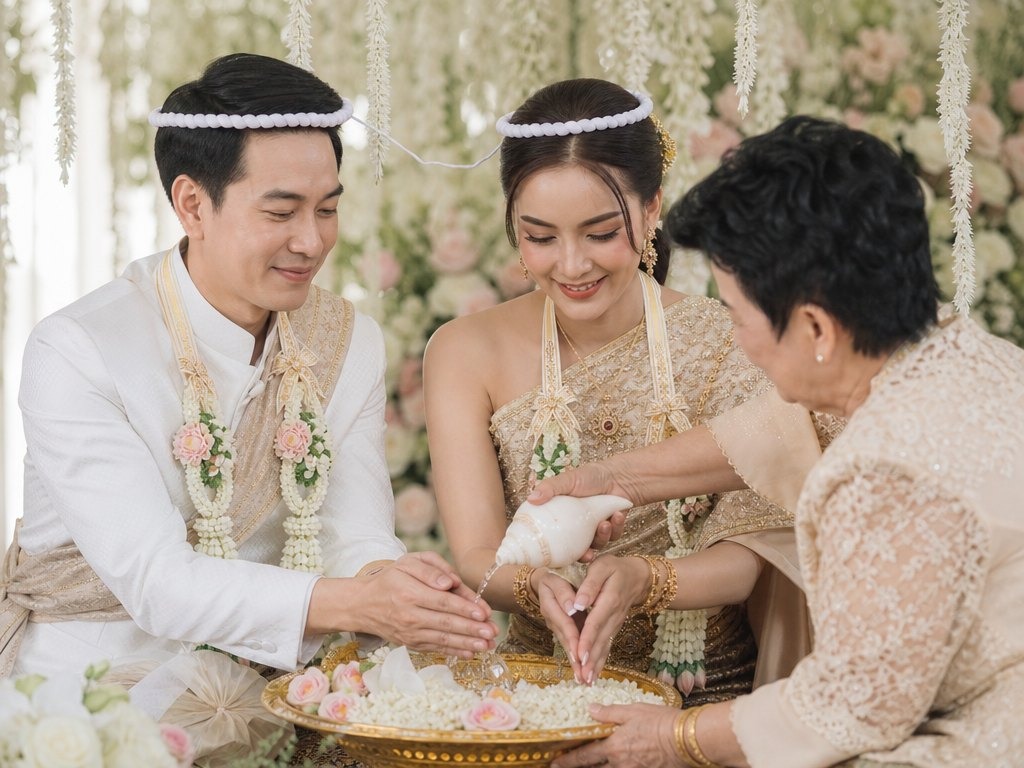
The heart of a traditional Thai wedding is Rod Nam Sang, the water-pouring ceremony. The bride and groom sit side by side with their hands pressed together in a wai, resting over a bowl or tray of flowers. Their heads are linked by sai mongkhon, a pair of joined white thread loops blessed in advance, which symbolise that the two lives are now connected.
Elders and guests come forward one by one. Each pours a little blessed water from a conch shell over the couple’s hands and offers a short wish for their future. The most senior family members go first. When everyone has had a turn, the couple often receives a gift or envelope from each guest.
In northern and northeastern Thailand, couples may also hold a bai sri su khwan ceremony, where elders tie white cotton threads around the couple’s wrists for good fortune.
Flowers at a Thai wedding
Flowers run through almost every step of the day. Jasmine garlands, known as phuang malai, decorate the trays, the ceremony area and the guests. Orchids, roses and marigolds fill the bowls beneath the couple’s hands during the water blessing, and many couples choose white and pastel flowers to keep the setting soft and bright.
Flowers are also one of the easiest ways to take part when you cannot attend in person. A bouquet with a short card delivered to the couple’s home or the venue on the day is a warm, well-understood gesture. Many local florists offer congratulations bouquets that can be ordered online and sent across Thailand, which works well for friends and relatives overseas. The same bouquets suit anniversaries later on, too.
What guests should know
If you have been invited to a Thai wedding, a few simple points will help:
- Gifts: Thai guests usually give money in an envelope rather than a boxed present. Write your name on the envelope so the couple knows who it came from.
- Clothing: Wear smart, modest clothes. Bright and pastel colours are welcome. Many guests avoid all-black outfits, since black is closely linked with funerals in Thailand.
- Timing: Morning rituals are mainly for family. Most guests are invited to the water blessing or the evening reception, so check your invitation.
- Etiquette: Follow the lead of others, especially around monks and elders. When in doubt, a polite wai and a smile go a long way.
Making a marriage in Thailand legal
A traditional ceremony, however meaningful, does not by itself make a marriage legal in Thailand. Legal marriage happens when the couple registers at a district office, called an amphoe or khet. Couples can register before or after the ceremony.
Foreign nationals usually need extra paperwork. Most embassies issue a document, often called an affirmation or certificate of freedom to marry, which then has to be translated into Thai and legalised by the Thai Ministry of Foreign Affairs before the district office will accept it. Requirements vary by nationality, so check with your embassy well in advance.
Thailand also changed its marriage law recently. Since 23 January 2025, same-sex marriage has been legal in Thailand, making it the first country in Southeast Asia to recognise marriage equality. Same-sex couples can now register their marriage at a district office on the same terms as other couples.
Planning a destination wedding in Thailand
Thailand is a popular place for destination weddings, from beach ceremonies in Phuket and Koh Samui to garden weddings in Chiang Mai. Many international couples blend the two worlds: a Western-style vow ceremony followed by a short Rod Nam Sang blessing, or a morning monk blessing before a beach reception.
If you are planning a wedding in Thailand from abroad, a local wedding planner can help with venues, monks, Thai-speaking officiants and paperwork. Book early for the cool season, roughly November to February, as it is the busiest time of year for weddings.
A celebration of family
What makes Thai wedding traditions so memorable is how much they centre on family. Every step, from the procession to the water blessing, invites relatives and friends to take part and to offer their good wishes in person. Whether you are walking in the Khan Maak procession, pouring water over the couple’s hands or sending flowers from the other side of the world, you are joining in a celebration that is about two families coming together.